Trusted by sailors since 1978 – available in print & eBook
Norway Winter
Leaving Your Boat in Norway Over the Winter
More on storing a foreign recreational boat in Norway – Tolletaten
Leaving your boat in Norway over the winter means you can spend several seasons enjoying the coast without the need for a long passage up and back each year. A second benefit is that it gives you the chance to take advantage of early and late season cruising, which, due to the wealth of snug harbours, can be very practical. It also gives you the opportunity to avoid the crowding in south Norway during July, which is the traditional time for Norwegians to take their holiday.
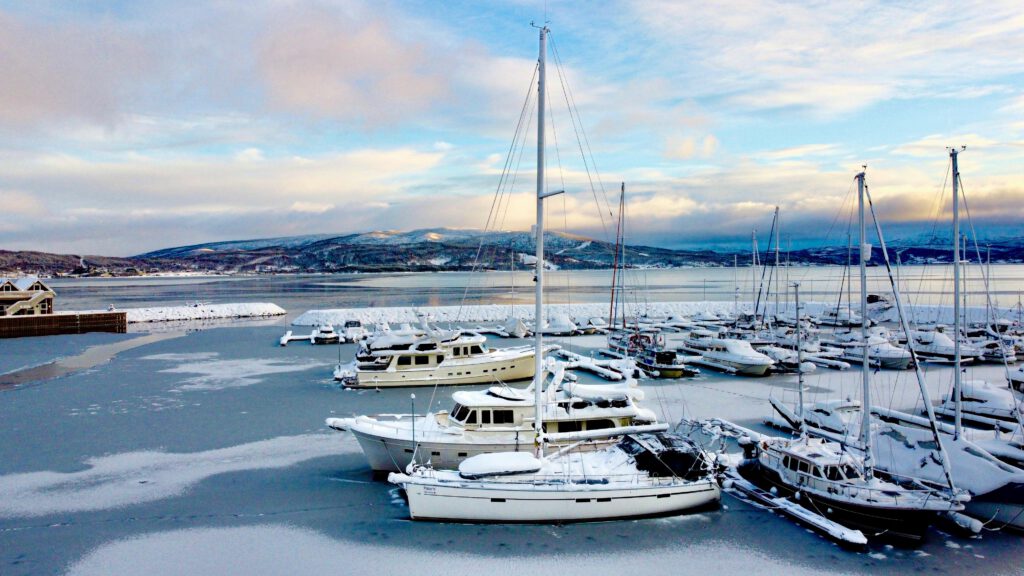
Early in the season the days are getting longer, the weather is often drier than during mid-summer, and there is still enough snow remaining on the high peaks in April and May to enhance the scenery. In September and October the leaves are gold and red and the peaks are dusted with new snow. And, as the hours of darkness increase in the autumn, the nordlys (the northern lights) become visible again.
Boat Storage Availability and Cost
There are few full-service boatyards in Norway, though the growing leisure boat market is pushing the development of these facilities.
Boatyards and Boat Storage Facilities
Most facilities, understandably, give priority to local customers. Since many customers don’t commit until around mid-August, most yards won’t know until then how much room they have left for visiting boats. As a result, if you don’t have a definite commitment from a yard to store your boat well ahead of time, you may have to wait until the end of the season to find a place. And finding undercover storage is unlikely.
Winter Climate
The southeast coast regularly freezes over and so most smaller boats are stored ashore for the winter. Wintering in the water is offered in marinas that have air-bubble or other systems to prevent ice from forming. The last of this ice, found in shallow anchorages and behind islands, is usually gone by the end of April. In winter, daytime temperatures typically range between -10°C and 0°C with nighttime temperatures reaching a low of -20°C.
From Egersund northwards some of the fjords may cover with ice, as will shallow anchorages with fresh water entering from rivers or streams, but elsewhere most boats are kept in the water all year. Temperatures at sea level are surprisingly benign; even above the Arctic Circle the temperature is typically around +5°C to -5°C and seldom goes below -10°C. The record nighttime low temperature in Tromsø is only -20°C. Strong winds are more of a problem and a sheltered berth or strong cradle is essential. Again, most of the ice, even deep in the fjords, will be gone by the end of April, unless it is an unusually severe winter.
If you are planning to leave your boat in the water over the winter, don’t underestimate the climate! Some parts of the coast get large amounts of snow and we highly recommend that you prepare your boat for this extra weight and make arrangements with someone to keep an eye on your boat over the winter.
If wintering ashore with the mast up, make sure your location is suitable for this and that the yard has experience with such a setup. Yachts have toppled over when not stored appropriately.
Sailing During the Winter
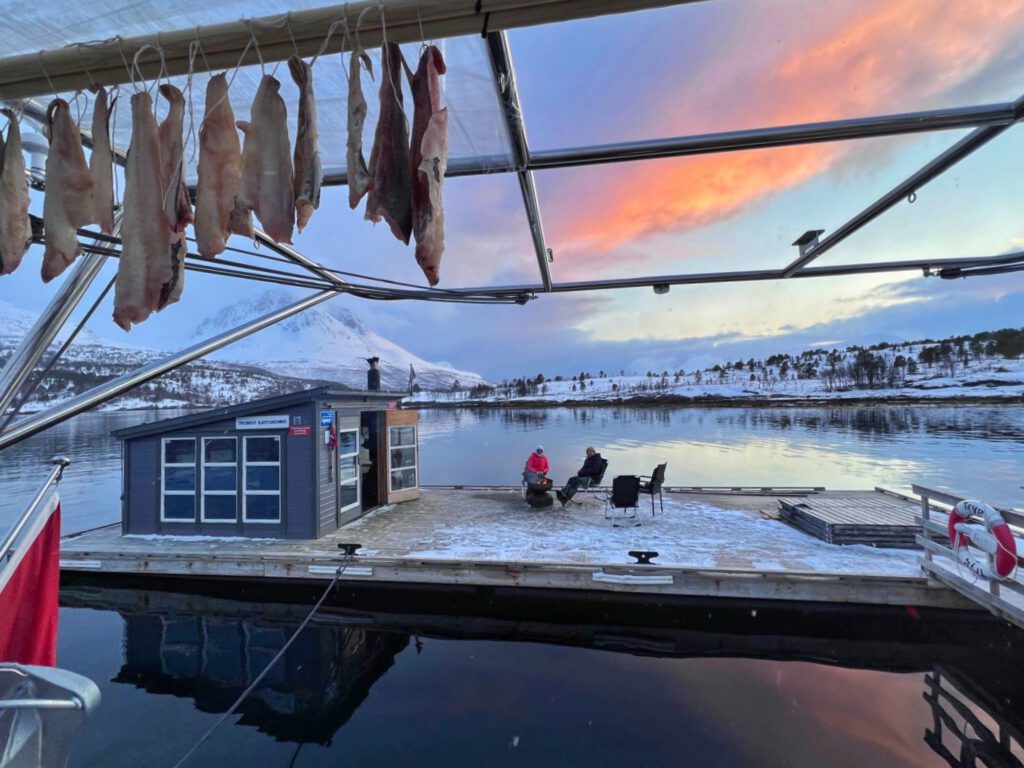
Sailing during the winter is increasingly popular: for whale watching in late fall, ski-and-sail trips later in the winter, or sailing in search of the northern lights.
Where
Because the southeast coast freezes and the Barents Sea coast is very exposed with few snug harbours, these areas do not readily lend themselves to winter cruising; however, much of the coast between Tananger and Tromsø (Volumes 1, 2 and 3), with its sheltering skjærgård and many snug harbours, is usually doable.
Lately, however, the winters on the south-east coast are becoming milder, and local sailors now regularly use their yachts during the winter. In fact, a group organises a sail-in-company from Vestfold to Strømstad in Sweden every February.
Whale Watching
Historically, a large population of orcas have followed the herring into Tysfjorden, Ofotfjorden and inner Vestfjorden between October and January.
Over the years the best area for observing the whales has moved further north, to the waters between Tromsø and Andenes, and even more recently to the Skjervøy and Seglvik area, and there is a growing whale watching industry in this area (Volume 3).
The Northern Lights (nordlys, aurora borealis)
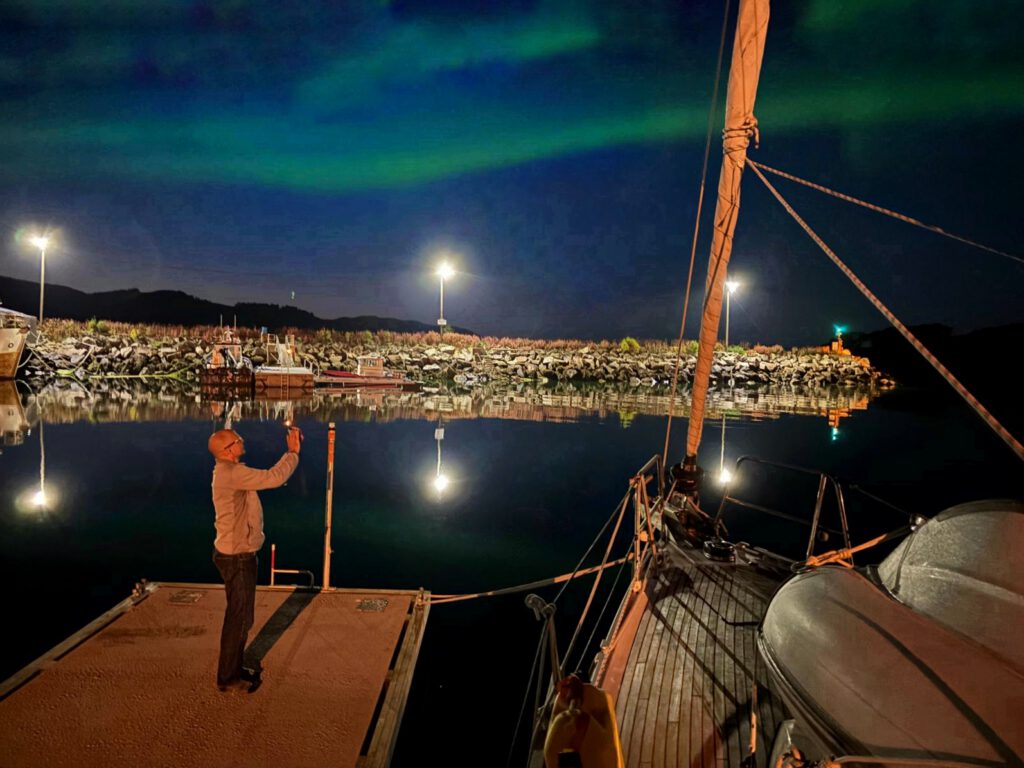
The northern lights are visible across northern Norway on clear nights from late September to early April. They are best viewed above the Arctic Circle. Their displays range from faint green glows to vivid curtains of green, purple, or red, shifting rapidly across the sky.
The frequency is high in winter months, often several nights per week during active periods. Their appearance varies from minutes to several hours, depending on solar activity. Darkness, clear skies, and minimal light pollution are essential for good viewing.
Weather and Weather Forecasts
The information below is in addition to that presented in the Weather and Weather Forecasts chapter.
Just as in the summer, weather conditions in the winter may vary markedly from year to year; however, January and the first half of February are known for a lot of bad weather and this, along with the mørketid (the darktime), requires patience, a good heater and a lot of books to read while you are waiting in a sheltered harbour for the conditions to improve. If you want to avoid bad weather — and it can be very bad, as discussed below — you must be patient and flexible.
Wind
- Generally, the weather changes much faster in the winter than it does in the summer, with much stronger highs and lows.
- Easterly winds tend to bring cold air while westerly winds bring warmer temperatures. Often, a period of cold weather is followed by a shorter period of temperatures at or slightly above 0°, partly melting any snow.
- Fjords are prone to katabatic gusting. The air behaves almost like water in a river, meandering and even changing direction, and moving faster where the fjord is narrower.
- Fallvinder (katabatic gusts), found in otherwise sheltered anchorages, are stronger in winter than in summer and are often accompanied by a noticeable temperature drop in the gusts. They seem to occur most often with a clear night sky.
Knowing this and taking local topography into consideration, you may find that you are able to forecast local winds with some success.
Temperature and Visibility
- Temperatures inside the fjords are often much lower than at the coast.
- The visibility is usually very good, except when there are snow showers, as fog is very rare during the winter.
- By the beginning of March the sun has returned and the weather should be less extreme, with longer periods of warmer sunny weather and deep snow.
Weather Forecasts And Polar Lows
Getting good forecasts is even more important in the winter than in the summer, in order to ensure that you are in a safe place when bad weather arrives. Polar lows are intense local cyclones unique to the polar regions. Forecasting these has been notoriously difficult. With improved models and better satellite observations, polar lows will now usually be forecast 24 hours ahead of time on yr.no. Access to daily weather forecasts is more important in winter than in summer.
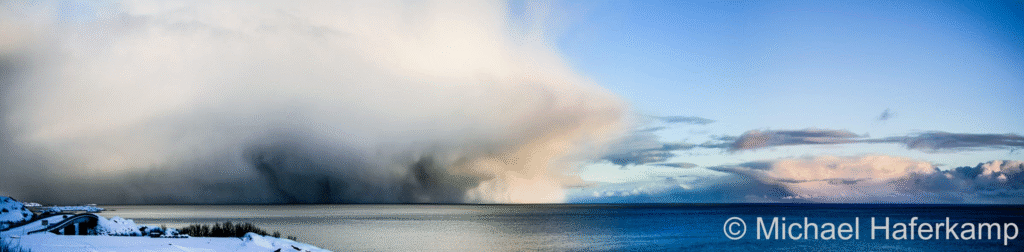
VHF gale warnings are not that helpful as there are so many in the winter, they are only given 24 hours in advance, and they cover large areas within which the weather may be extremely variable.
Ice
Though the west coast is generally ice-free during the whole winter, due to the influence of the Gulf Stream, the following conditions lend themselves to ice formation:
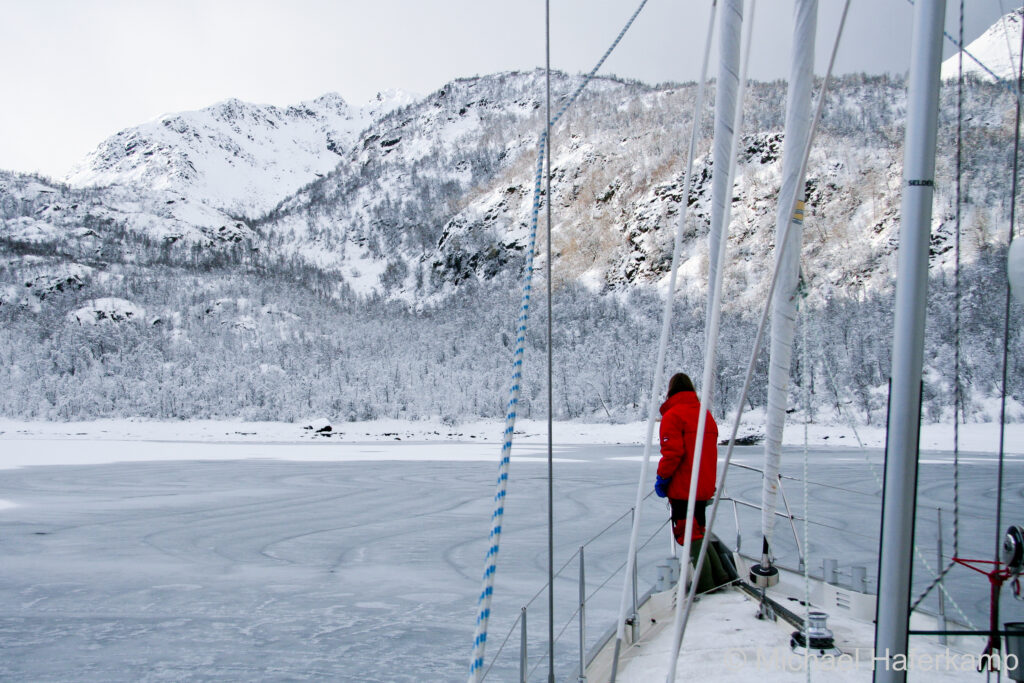
- A period of calm, cold weather;
- Shallow water;
- Inland anchorages and harbours have a higher risk of ice;
- Anchorages with little water exchange have a higher risk of ice;
- The presence of fresh water from a river will cause ice forming as fresh water tends to layer on top of heavier salty sea water and freezes at a higher;
- An area along the shore that dries at low tide will tend to accumulate ice, which sometimes starts to drift away at high tide in offshore winds, making it uncomfortable and even dangerous to anchor in case a piece of ice gets pushed against the anchor chain by the tide and wind.
Information about sea ice
Ice charts
Barentswatch.no
Icing
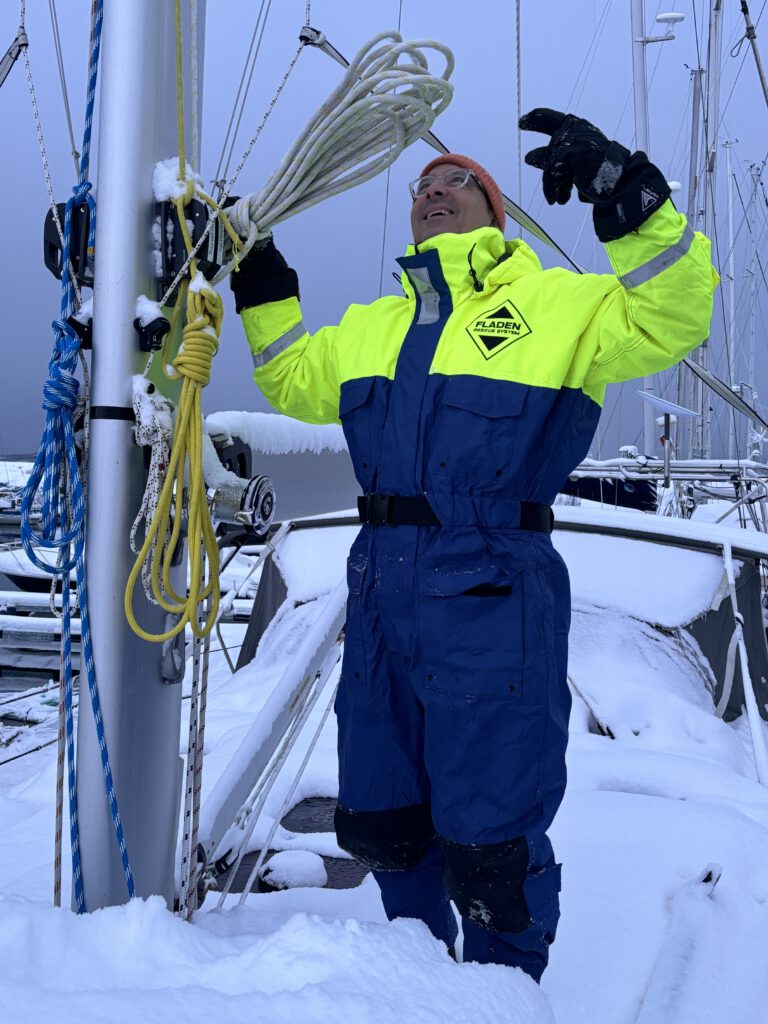
When the temperature drops below -2°C, sea spray can freeze in the air and fall back like wet snow. It builds up as a thick, hard layer of ice on the boat. Lines, sheets and halyards can freeze solid and become stiff like metal wires. The deck can turn very slippery and dangerous, and the anchor chain may freeze to a solid lump inside the locker.
It is strongly advised not to sail in these conditions. Ice can build up very quickly and may affect the boat’s stability.
Daylight
In Lofoten in mid-January you will only have enough light to enter unlit anchorages, or to walk or to ski, for four to six hours a day on a clear day; less on an overcast day. By mid-February you will already have ten hours of daylight.
Harbours
Electricity is generally available in winter at the same locations as in summer. In some places in Northern Norway, water is also available during winter, as taps are left running to prevent freezing or the fresh water system is protected from freezing in heated and insulated boxes.
Some harbours prefer not to have larger sailboats moored on floating pontoons during winter because strong winds can cause damage. However, an alternative berth alongside a fixed wharf is usually available.
Winter Fishery
Lofoten is famous for its winter cod fishery; however, local fisherfolk report that the season is now much shorter than it used to be. The timing of the fishery changes from year to year, which makes it hard to predict when the harbours might be crowded with fishing boats, leaving no room for a visiting boat, but generally it takes place mainly in March in Vestfjorden and outside Røst it starts in January and February.
Spikes (Brodder)
In north Norway roads and sidewalks are often covered with a thick layer of ice, which can make walking a bit treacherous. Spikes (brodder), which attach to your shoes, can help keep you upright.